
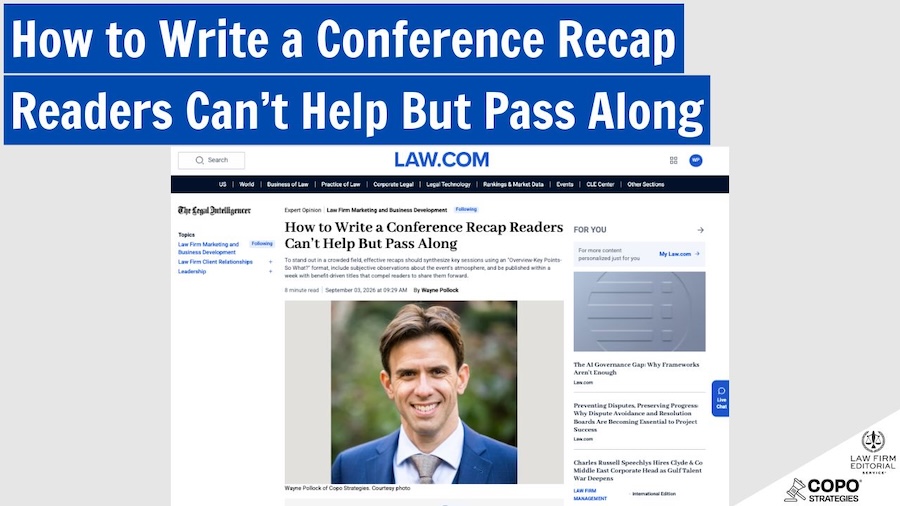
Conference recaps are marketing AND client service tools. Here’s how to craft recaps that your past, current, and future clients actually want to read (and share with others)
Schools are back in session, Halloween candy is on store shelves, and pumpkin-spice flavored everything is on just about every menu you look at. That could only mean one thing—the start of the autumn conference season is here.
Attending conferences will boost your marketing and business development efforts by providing you countless opportunities for face-to-face networking. But attending conferences will also provide you material for a marketing and business development tool that gives you an excuse to reach out to current and prospective clients and referral sources, as well as conference attendees you’d like to follow up with: a conference recap.
A conference recap in the form of a client alert, blog post, or bylined article that walks a reader through what you heard and learned at a conference you attended does two jobs simultaneously. It builds your reputation with recipients by showing you understand the issues their industry is wrestling with, while giving them relevant takeaways from a conference they didn’t attend or that they attended but didn’t take decent notes at.
The problem is that most attorneys already know this, so the format is crowded. Generic “Five takeaways from the ABC conference” articles are a dime a dozen and easy to ignore. What follows are five best practices for writing conference recaps that people actually read and forward to a colleague—which is how your writing reaches people who’ve never heard of you.
One foundational point to start from before you start taking notes at a conference: listen on two tracks. At any conference, some of what you’ll hear will be useful to you as a practicing attorney serving clients, while other material will be useful to your clients in that it will help them run their businesses or do their jobs better. Build your recap from that second category. Knowing which bucket an idea belongs to in real time frees you up to take usable notes instead of playing the role of court reporter and attempting to create a real-time transcript of sessions you attend.
Describe sessions by providing an overview, key points, and a “so what?”
The hardest parts of writing a conference recap are deciding which material you’ll include and structuring it in a way that gives a busy reader an opportunity to digest it with ease. Consider using the “O-K-So?” format to help on both fronts.
Overview. In a sentence or two, set up the panel or session. List the speakers and their roles at their organizations so a reader can judge whose views are being shared and the credibility they bring to the conversation.
Key points. Pull three points from the session that are most relevant to your audience. Choosing three points prevents you from burying the reader with too much information but gives them enough relevant substance to chew on.
So what? Explain why those points matter to the reader, and, when applicable, what they should consider doing about them. This is the part many recaps skip, but it provides the most value and gives you the opportunity to show off your intellectual chops. Any conference attendee who’s half paying attention can report what was said during a session. But connecting what was said to what your readers care about makes your recap worth reading, and makes you, hopefully, worth calling when a related issue emerges.
You’ll devote about 200 to 350 words per session to explaining to readers what was said, why it matters, and what to do next. Do that for three to five sessions, and you’ll give your readers plenty of food for thought about the conference without having to write a novel.
A recap is a synthesis, not a transcript
Once you’ve built the structure for your recap, resist the urge to repeat everything you heard at the sessions you’re writing about. You’re not a court reporter; you’re a summarizer and a “Why you should care”-er. Keep your paragraphs and sections short and make the piece skimmable so your readers can move through it quickly.
This is harder than it sounds. Compressing several panels into a few tight sections takes skill, which is why doing so provides value and why so few conference recaps effectively pull it off. Aim for a document that’s between 700 and 1,500 words long. If you have a topic that you can’t seem to squeeze in because you have a lot to say about it, congratulations—you just landed on a topic to cover in a follow-up alert/blog post/article.
Include a “read of the room“
In every conference recap I’ve read, the writer sticks to the sessions and stops there. None of them described the vibes of the conference. That’s why your recap should.
A section describing the event’s vibes is subjective, but that’s the point. It’s something only an attendee can offer. But you’re not just any attendee; you’re an attendee who serves the audience you’re writing this recap for, so your subjective musings will be especially relevant to your readers. When giving your “read of the room,” consider discussing:
– What people were talking about between sessions, at lunch, at the reception, in the hallways, etc.
– The mood of the crowd. Were they confident? Anxious? Cautiously optimistic?
– Short, anonymized anecdotes, such as “A general counsel at a mid-size manufacturer told me she’s already seeing the trend of . . . .”
– Anything else you observed outside of the sessions.
Done well, this section puts the reader in the conference venue with you, observing and absorbing the conference’s vibes, while also eliminating their FOMO. Depending on what you hear outside of the sessions, this could be the most interesting, relevant, and memorable section of your recap.
Share the underlying materials
When crafting your recap, don’t ignore the materials shared during the conference. If a speaker made slides or other resources available and you found them useful, your readers probably will too. Link to them in your recap, or attach them to it, even for sessions you didn’t cover in depth. A line or two on what you found interesting about these materials and why you’re sharing them shows readers you’re thinking of them.
Package your recap with a benefit-driven title, and publish it within a week
Don’t let your hard work crafting your recap go to waste by producing one that doesn’t get read. Give your recap an irresistible title and publish it within a week or so of the conference wrapping up to maximize the number of people who want to read it and pass it along.
As for the title, there’s nothing wrong with “takeaways” or “recap,” but a title like “Five takeaways from the ABC Conference” criminally undersells the value of your recap.
Write a headline that places front and center the benefit gained from reading the recap. “Five takeaways from the ABC Conference that GCs should act on before their fiscal year ends” tells a GC that you’re sharing information they’ll want to act on in a timely manner. Note that it’s often easier to write your title after you’ve written your first draft, so you have a sense of your recap’s theme.
As for timing, recaps have a shelf life. You don’t have to be first to report on a conference, nor should you aim to be because if you are, you won’t give yourself adequate time to think about and absorb the takeaways from the conference most relevant to your audience. You want to be the attendee who best connects what happened at the conference to what your readers care about. Those thoughts take time to coalesce.
The sweet spot for publishing your conference recap is within a week of the conference ending. It will be recent enough that the conference will still be on your readers’ minds, but it gives you enough time to produce a thoughtful recap. If you wait much longer, memories fade, your readers move on, and your competitors might jump the line with a recap that your target audience finds authoritative.
Go for the networking, stay for the recap source material
Your primary marketing and business development objective when attending conferences is to engage in the face-to-face chit-chatting with current and new members of your network that’s becoming an increasing rarity in today’s always-online world. But the information you absorb in sessions you attend at the conference, and your observations of the vibe of it, can be communicated to your current and prospective clients and referral sources in the form of a conference recap that is a valuable marketing and business development tool in its own right.
Well-written, relevant conference recaps help you build your standing with people who might one day become clients, while educating the clients you already have and deepening your relationship with them. Following the five tips above will help you do this, and in the process, write a recap that’s so relevant, useful, and clear that readers can’t help but pass it along to people in their network, introducing you to exponentially more potential clients and referral sources.
Wayne Pollock, a former Am Law 50 senior litigation associate, is the founder of the Law Firm Editorial Service, a thought leadership consulting and ghostwriting service. The Law Firm Editorial Service helps law firm partners and executives at organizations serving the legal industry produce high-quality, human-written thought leadership articles that meet their exacting standards in a fraction of the time they would typically spend writing them. He can be reached at wayne@lawfirmeditorialservice.com.
Reprinted with permission from the September 3, 2026, edition of The Legal Intelligencer © 2026 ALM Media Properties, LLC. All rights reserved. Further duplication without permission is prohibited, contact 877-257-3382 or reprints@alm.com.
Want to build a thought leadership strategy that works? Take our free Thought Leadership Gap Finder and discover exactly where your content strategy has gaps — and what to do about it. Or, learn more about how LFES works with attorneys to produce consistent, high-quality thought leadership without the time investment.